The contrast between the dense glacial till underlying Newmarket's elevated historic core and the compressible organic soils blanketing the floodplain near the Holland River defines the permeability challenges we encounter in this region. On a site near Fairy Lake, the sandy outwash deposits can accept water at rates that would surprise anyone accustomed to the tight clay tills just two kilometers east along Davis Drive. These abrupt lateral variations mean that a single assumed hydraulic conductivity value from a desktop study rarely captures what is actually happening below the surface. Before committing to a dewatering strategy or designing a cutoff wall, the team will often combine a Lugeon test in weathered bedrock with a CPT investigation to map the transition from granular overburden into the Queenston Shale, ensuring that no high-permeability fracture zone goes undetected.
A single Lugeon test in the fractured Queenston Shale reveals more about potential groundwater inflow than a dozen laboratory permeability tests on intact core samples.
Methodology and scope
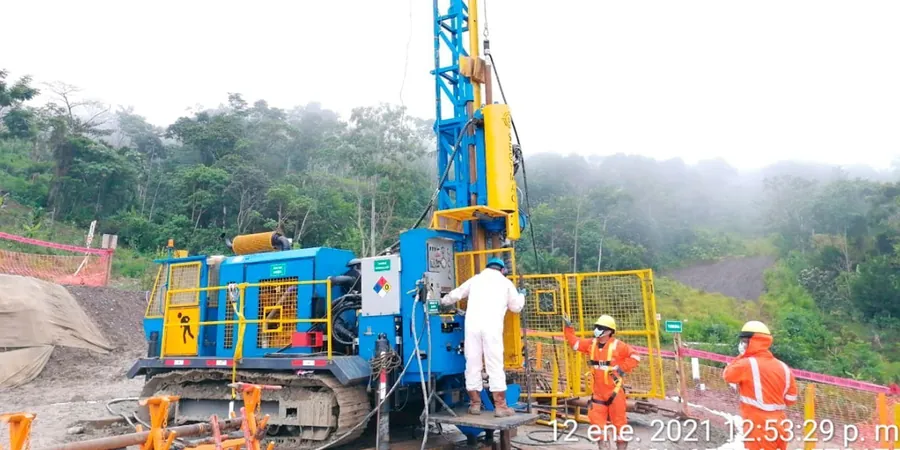
Local considerations
The Holland Marsh basin, just north of Newmarket, sits on up to 20 meters of highly compressible organic silt and peat with a water table consistently within 1.5 meters of the surface. In this depositional environment, a Lefranc test conducted without proper filter pack isolation can underestimate the true bulk permeability by a factor of three or more, leading to undersized dewatering pumps and costly excavation delays. The harder risk to manage appears in the transition zone where the organic deposits pinch out against the Oak Ridges Moraine sediments: here, preferential flow paths along buried sand channels can direct groundwater toward an excavation from distances far greater than the property boundary. When a Lugeon test in the underlying shale returns values above 25 Lu, the fracture aperture is large enough that cement-based grouts will not travel effectively, and the grouting strategy must shift to microfine cements or chemical alternatives to achieve the specified residual permeability. Skipping in-situ testing in favor of lab permeameter values creates a gap between the design assumption and the actual subsurface condition that no factor of safety can reliably bridge.
Explanatory video
Applicable standards
ASTM D6391 – Standard Test Method for Field Measurement of Hydraulic Conductivity Using Borehole Infiltration (Lefranc), ASTM D4630 – Standard Test Method for Determining Transmissivity and Storage Coefficient of Low-Permeability Rocks by Packer Test (Lugeon), Houlsby (1976) – Routine assessment of Lugeon test data for grouting decisions, Ontario Building Code (OBC) – Division B, Part 4 – Structural Design, CSA A23.3 – Design of Concrete Structures (drainage and waterproofing provisions)
Associated technical services
Lefranc Permeability Test in Overburden
Borehole infiltration test performed at discrete intervals within granular or cohesive soils using a screened casing and constant or falling-head configuration. We execute the test immediately after SPT sampling to correlate hydraulic conductivity with the logged stratigraphy, providing the k-value directly to the dewatering contractor and the excavation designer.
Lugeon Packer Test in Bedrock
Downhole pressure test conducted in fractured shale, limestone, or sandstone using a pneumatic packer to isolate 3–5 m test intervals. The Houlsby interpretation of the pressure-versus-flow curve distinguishes between laminar flow through tight joints and turbulent washout in open fractures, which is essential for specifying grout mix rheology and refusal criteria.
Typical parameters
Frequently asked questions
What is the typical cost for a field permeability test in Newmarket?
The cost for a single Lefranc or Lugeon test in the Newmarket area typically falls between CA$780 and CA$1,540, depending on the test depth, number of intervals, and whether it is performed during an existing drilling program or requires a dedicated borehole. Packer tests in bedrock through overburden casing are at the higher end due to the additional setup time and equipment required.
When is a Lugeon test preferred over a Lefranc test?
A Lugeon test is the appropriate choice when the target formation is fractured bedrock, such as the Queenston Shale or the limestone of the Bobcaygeon Formation found beneath the overburden in parts of York Region. The Lugeon test isolates a specific rock interval with a packer and applies controlled pressure to measure fracture flow, whereas the Lefranc test is designed for unconsolidated soils and cannot capture the anisotropic flow regime of a jointed rock mass.
How many test intervals should a Lugeon test include for a grouting design?
For a reliable grouting design, the Lugeon test should cover every 3 to 5 meters of the borehole within the zone of interest, with at least three pressure stages per interval following the Houlsby routine. This staged approach reveals whether the fracture network dilates or clogs under pressure, which directly influences the selection of grout type, injection pressure, and refusal criteria before the grouting program begins.
Does the shallow water table in the Holland Marsh area affect Lefranc testing?
Yes, the high groundwater table in the Holland Marsh basin and the surrounding low-lying areas of Newmarket means that many Lefranc tests are conducted in saturated or nearly saturated soils. The test procedure is adapted by using a shorter falling-head response time and closely monitoring the equilibrium water level in the borehole before starting the test, which prevents the overestimation of hydraulic conductivity that can occur if the filter zone is not fully saturated.