When we look at a site north of Davis Drive, the first thing we check is how much silty clay sits above the till. Newmarket’s glacial history left a patchwork of stiff Halton Till and pockets of softer glaciolacustrine deposits, and a shallow foundation design that ignores that variation will cost you later. A few kilometres east, near the Holland River, groundwater shows up less than two metres down, which changes bearing capacity and frost protection requirements completely. Our approach combines test pits for visual logging with lab index testing so the footing width and depth reflect what the ground actually holds, not what a textbook assumes. We work directly with your structural engineer to keep the excavation practical and the concrete quantities reasonable, delivering a foundation report that Ontario building officials accept without back‑and‑forth.
Newmarket's Halton Till can carry 200 kPa, but the silt lens sitting right above it may cut that value in half — and that's the layer your footing actually bears on.
Methodology and scope
Local considerations
A three‑storey medical office on Eagle Street started showing step cracks before the drywall was taped. The original geotechnical report had recommended 150 kPa based on one borehole in competent till, but the northwest corner of the building sat on a lens of soft silt that the single hole missed. Underpinning that corner after the fact cost more than the entire design‑phase investigation would have, and the clinic’s opening was delayed four months. In Newmarket, where the till surface can dip several metres across a single lot, a shallow foundation design needs at least two investigation points for a residential footprint and a grid for commercial work. We also check for desiccated crust that stiffens to 80 kPa near the surface but drops to 40 kPa at depth, because that crust masks the real settlement risk. A few thousand dollars spent on targeted boreholes and lab tests before excavation saves tens of thousands in remedial grouting and legal headaches.
Applicable standards
NBCC 2020 (Part 4 & geotechnical commentary), CSA A23.3-19 (design of concrete footings), ASTM D1586-18 (Standard Penetration Test), ASTM D4318-17e1 (Atterberg limits), CFEM – Canadian Foundation Engineering Manual (4th ed.)
Associated technical services
Residential Footing Design
Bearing capacity and settlement analysis for single‑family homes, townhouses, and duplexes. Includes frost‑depth verification and a stamped report for the building permit application.
Commercial Mat Foundation Design
Rigid mat design for low‑rise commercial buildings on variable ground. We model soil‑structure interaction to reduce differential settlement and optimize slab reinforcement.
Soil Investigation Package
Boreholes, test pits, and lab testing (Atterberg, triaxial, grain size) tailored to Newmarket's glacial stratigraphy. Delivers the geotechnical parameters your structural engineer needs.
Construction Review & Bearing Confirmation
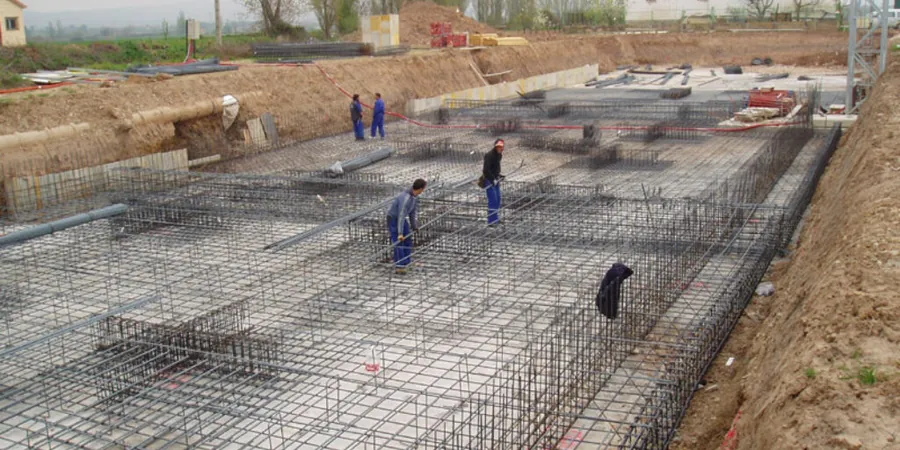
On‑site inspection during excavation to confirm the bearing stratum matches the design assumptions. We use a dynamic cone penetrometer or hand‑auger checks to verify consistency before the rebar goes in.
Typical parameters
Frequently asked questions
What does a shallow foundation design cost for a house in Newmarket?
For a typical single‑family home in Newmarket, the combined investigation and design report falls in the CA$2,310 to CA$4,290 range. The spread depends on the number of boreholes required and whether lab testing beyond index properties is needed. Larger lots or sites near the Holland River floodplain tend toward the upper end because groundwater monitoring adds time.
How deep do footings need to be in Newmarket to avoid frost heave?
The NBCC 2020 sets the frost penetration depth for the Newmarket area at 1.2 metres below finished grade. We typically specify a minimum 1.4‑metre embedment to provide a margin against extreme winters and to reach undisturbed till. If the site has silty clay with high capillary rise, we may also recommend a granular pad beneath the footing to break the capillary path.
Can I use a shallow foundation if my site has soft silt near the surface?
In many cases, yes, but the design needs to account for that soft layer explicitly. Options include widening the footing to reduce bearing pressure, excavating the silt and replacing it with engineered fill, or switching to a mat foundation that bridges the softer pockets. We evaluate the thickness and depth of the silt lens during the investigation and run settlement calculations for each scenario before recommending the most cost‑effective approach.
How long does the investigation and design process take?
Fieldwork usually takes one day for a residential lot, followed by two to three weeks for lab testing and report preparation. Commercial projects with multiple boreholes and triaxial testing may take four weeks. We can often expedite the preliminary bearing recommendations within a few days of drilling so your excavation schedule isn't held up.