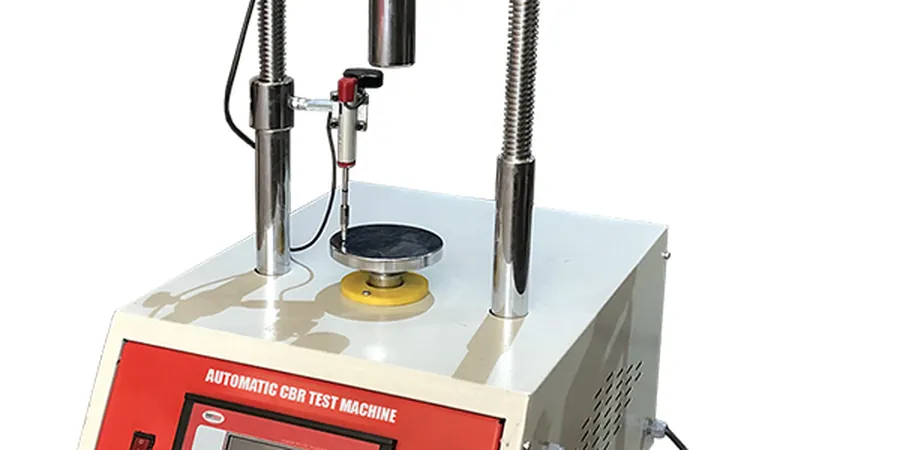
Building a road or parking lot in Newmarket means accounting for what happens underground when winter finally breaks. The Holland Marsh influence and the town's silty-clay tills create subgrade conditions that soften dramatically during the spring melt, and a pavement designed on dry-strength numbers will rut within two seasons. That is exactly why a laboratory CBR test run under soaked conditions matters here. We compact remolded samples at target density and submerge them for 96 hours before penetrating, giving you a California Bearing Ratio value that reflects the worst-case scenario your pavement will actually face. For subgrades near the East Holland River or in the newer developments west of Yonge Street, this soaked CBR number becomes the backbone of the granular base and asphalt thickness design, and skipping it means gambling with a repair bill that dwarfs the cost of a proper Proctor test and CBR combo before the first truck rolls.
A soaked CBR value is not a number on a report; it is your pavement's performance during the first spring breakup after construction.
Methodology and scope
Local considerations
Newmarket's surficial geology maps show a mix of Halton Till and glaciolacustrine deposits draped over the Oak Ridges Moraine complex, and that means CBR values can swing from 2% in a wet clay pocket to over 15% in a dense sandy till within the same site. The risk is not just low strength; it is variability. A pavement section designed on one optimistic CBR number will develop longitudinal cracking and edge failure where the subgrade changes, and those repairs hit the maintenance budget hard within the first five years. We see this pattern repeatedly in commercial developments along Harry Walker Parkway, where cut-and-fill transitions create differential subgrade stiffness. Running CBR tests on samples from each distinct soil unit, not just one composite, gives the pavement designer the information to either vary the granular base thickness or stabilize the weaker zones before paving. The cost of an extra CBR point is trivial next to a premature overlay cycle.
Applicable standards
ASTM D1883-21: Standard Test Method for California Bearing Ratio (CBR) of Laboratory-Compacted Soils, ASTM D698-12: Standard Test Methods for Laboratory Compaction Characteristics of Soil Using Standard Effort, Ontario Provincial Standard Specification OPSS 1010: Material Specification for Aggregates – Base, Subbase, Select Subgrade, and Backfill Material
Associated technical services
Soaked CBR per ASTM D1883
Three-point remolded CBR with 96-hour soak, swell measurement, and penetration resistance at 0.1 in and 0.2 in. We match the compaction effort to your project specification, whether Modified or Standard Proctor, and report CBR values corrected for stress-penetration curve shape per the standard.
CBR plus Proctor and gradation package
A bundled test sequence that starts with a standard Proctor to establish optimum moisture and maximum dry density, runs the CBR at three moisture points bracketing optimum, and wraps with a washed sieve analysis to classify the subgrade per the Ontario Provincial Standard Specifications. One sample submission, all the data your pavement designer needs.
Typical parameters
Frequently asked questions
How much does a laboratory CBR test cost in Newmarket?
A standard soaked CBR test with three-point compaction (three specimens) typically runs between CA$180 and CA$270 per point, depending on whether the Proctor is included or already established. Most Newmarket projects need two to three CBR points to cover the site variability, and we can quote a package price once we see the borehole logs or test pit locations.
Why is a soaked CBR value so important for Newmarket pavements?
Newmarket sits on glacial till and glaciolacustrine silts that hold moisture through the winter freeze. When the ground thaws in March and April, the subgrade can reach near-saturated conditions right when construction traffic starts moving. A soaked CBR test replicates that worst-case saturation over a 96-hour submersion period, so your pavement design uses a strength value that represents spring breakup, not the dry summer conditions when the soil looks deceptively strong.
How long does it take to get CBR results from your lab?
The full soaked CBR procedure requires 96 hours of submersion plus compaction and penetration testing time, so standard turnaround is five to seven business days from sample receipt. We can accommodate rush requests for time-sensitive projects, but the soak period is fixed by ASTM D1883 and cannot be shortened without compromising the result. We recommend sampling early in the investigation phase so the CBR data is ready when the pavement designer needs it.