Newmarket sits on the Oak Ridges Moraine, and anyone who has excavated here knows the subsurface can shift from dense sandy till to compressible glaciolacustrine clay within a single lot. That variability is why pile foundation design in Newmarket Ontario rarely follows a generic template. The upper silty clays often lack the bearing capacity for conventional footings, pushing structural loads down to the competent till or shale bedrock that lies anywhere from 8 to 25 m deep. In our experience, early integration of a CPT test provides a near-continuous strength profile that helps pinpoint the transition to competent bearing strata, while grain-size analysis on split-spoon samples confirms whether the till matrix is dense enough to develop the shaft friction assumed in design. With over 88,000 residents and steady infill development along Davis Drive and Yonge Street, the demand for reliable deep foundations in Newmarket has never been higher, and the Ontario Building Code’s reference to NBCC 2020 and CSA A23.3 sets a high bar for geotechnical input.
In Newmarket’s moraine deposits, the difference between a pile that settles 5 mm and one that settles 25 mm often comes down to correctly identifying the dense till interface—and that requires site-specific testing, not regional correlations.
Methodology and scope
For driven steel H-piles, the dense basal till often controls capacity, demanding dynamic monitoring with PDA to confirm the blow count correlates with the static resistance predicted by the β-method. Where vibration and noise are constrained—common near Southlake Regional Health Centre or the GO station—continuous flight auger piles offer a quieter alternative, with grout take and torque readings providing real-time quality control.
Material durability is equally important in Newmarket’s freeze-thaw climate: CSA A23.3 exposure classes C-1 and C-XL govern concrete cover and mix design for pile caps, and we specify sulphate-resistant cement where groundwater sampling indicates elevated sulphate concentrations in the Newmarket Till.
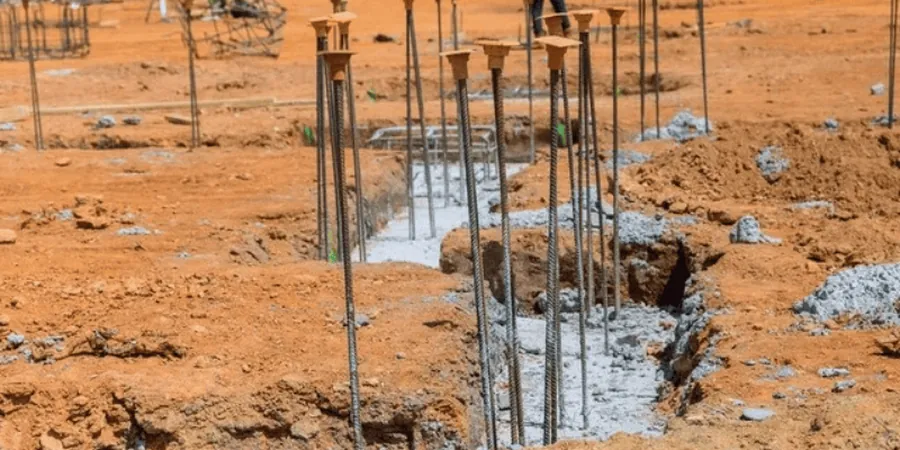
Local considerations
Newmarket’s development history stretches back to the early 1800s as a Quaker farming community, but its modern expansion across the moraine has left a patchwork of fill, buried organic soils, and undocumented former drainage courses. Relying solely on desktop geology without invasive investigation is the fastest route to a pile foundation underperformance.
The most frequent issues we encounter are excessive settlement when piles are terminated just above the dense till rather than keyed into it, and lateral spreading in deep clay zones where the undrained shear strength drops below 30 kPa. Frost heave on pile caps is another concern, particularly for lightly loaded structures, if the cap bottom is placed within the 1.2 m frost penetration depth typical of York Region. A properly scoped investigation that includes at least one borehole extending 5 m into competent till or shale, combined with laboratory consolidation tests on clay samples, eliminates most of these surprises before the first rig mobilizes.
Applicable standards
NBCC 2020 (National Building Code of Canada), CSA A23.3:19 Design of Concrete Structures, CFA Piling: DFI/CFA-Pile-Design-Guide (2019), ASTM D1143/D1143M Standard Test Methods for Deep Foundations Under Static Axial Compressive Load, ASTM D4945 Standard Test Method for High-Strain Dynamic Testing of Deep Foundations
Associated technical services
Geotechnical Investigation for Pile Design
Rotary sonic and hollow-stem auger drilling across the site, with SPT N-values, Shelby tube sampling in clay layers, and laboratory triaxial and consolidation testing to define strength and compressibility parameters for axial and lateral pile analysis.
Pile Capacity Analysis and Foundation Drawings
Static capacity calculations using the β-method for driven piles and FHWA method for CFA piles, including pile group efficiency, downdrag assessment where fill is present, and signed, sealed design drawings for building permit submission.
Pile Load Testing and Construction QA/QC
Static compression and lateral load tests conforming to ASTM D1143 and D3966, high-strain dynamic testing (PDA) during driving, and integrity testing (PIT) for augered cast-in-place piles to confirm shaft continuity and bulb formation.
Typical parameters
Frequently asked questions
How deep do piles typically need to go in Newmarket to reach competent bearing?
In most areas of Newmarket, the dense basal till or shale bedrock is encountered between 12 and 28 metres below grade, depending on whether you are on the high moraine or in a buried valley. A single design depth across a site is risky because the till surface can undulate significantly. We always recommend at least one borehole to 5 metres into competent material to confirm refusal criteria.
What does pile foundation design cost for a residential or small commercial project in Newmarket?
For a typical single-family home or small commercial building in Newmarket requiring 4 to 8 piles, the combined geotechnical investigation, design calculations, and sealed drawings generally range from CA$2,410 to CA$7,450. The spread depends on access constraints, depth to competent strata, and whether load testing is required by the municipality.
Is dynamic pile testing accepted by the Town of Newmarket building department?
Yes, high-strain dynamic testing (PDA) is widely accepted as a quality assurance method for driven piles in Newmarket, provided the testing follows ASTM D4945 and is correlated with at least one static load test or CAPWAP signal matching analysis. For CFA piles, we typically supplement PDA with low-strain integrity testing to confirm shaft continuity.