Newmarket's historical development along the Holland River floodplain created a legacy of infrastructure built on challenging glacial deposits. The compacted Halton Till, interspersed with interglacial silt and clay layers from the former Lake Algonquin, defines the subsurface character across York Region. When the Upper Yonge Street corridor requires new utilities or transit expansion, tunneling through these soft soils demands a geotechnical approach grounded in local stratigraphy. Our laboratory has processed hundreds of undisturbed samples from boreholes across the Newmarket area—from the sandy outwash near Fairy Lake to the sensitive clays east of the 404. Combining precise classification with triaxial testing under in-situ confining pressures gives us the strength parameters that directly feed into face stability calculations and crown settlement estimates for shallow tunnels.
In Newmarket's glacial deposits, the difference between a successful drive and a face collapse often comes down to 50 kPa of undrained shear strength.
Methodology and scope
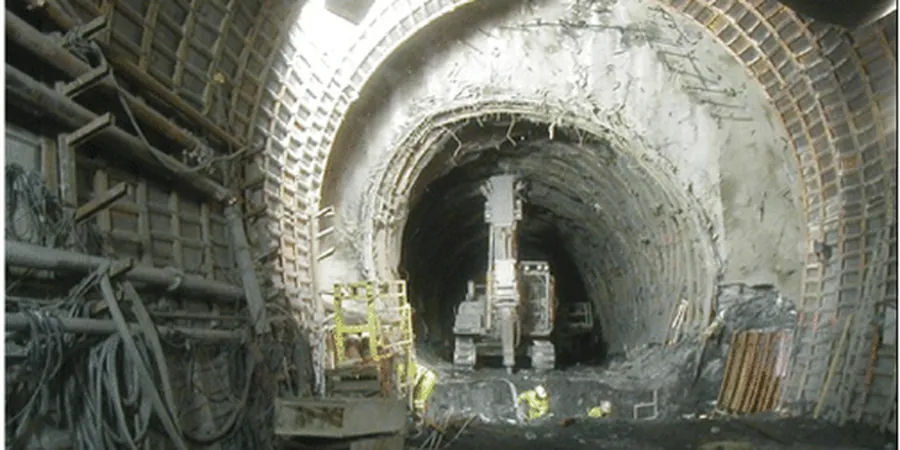
Local considerations
The Ontario Building Code references CSA A23.3 for concrete design, but the geotechnical risk in Newmarket tunneling is governed by groundwater behavior in the complex glacial stratigraphy rather than structural capacity alone. The 2019 flood event reminded everyone in the region how quickly the water table can rise within the upper sand units along the Holland River watershed. For tunnelers, this means an artesian condition can develop unexpectedly in a lens that appeared dry during the site investigation phase. Face loss into these saturated pockets is the primary risk we flag in our baseline reports. Following ASTM D4767 for consolidated-undrained triaxial testing, we define the critical state line that governs whether the soil will contract or dilate during shearing at the tunnel face. In Newmarket's sensitive clays, contractive behavior is the norm, requiring strict control of advance rate and muck conditioning to avoid a runaway loss of ground that propagates to surface within hours.
Explanatory video
Applicable standards
ASTM D4767 – Consolidated Undrained Triaxial Compression Test for Cohesive Soils, ASTM D2487 – Unified Soil Classification System (USCS) for glacial deposit characterization, CSA A23.3 – Design of Concrete Structures (for tunnel lining interaction with ground), ASTM D4318 – Atterberg Limits (for soft clay classification and sensitivity assessment)
Associated technical services
Advanced Triaxial Testing Program
We run CIU and CAU triaxial tests at confining pressures matching the tunnel depth across Newmarket's clay and till units. Stress-strain curves, pore pressure response, and effective stress paths are delivered with interpreted Mohr-Coulomb and critical state parameters for your PLAXIS or FLAC3D model.
Geotechnical Baseline Report Support
Using our regional database of Newmarket borehole logs and lab test results, we help establish defensible baseline values for undrained shear strength, permeability, and abrasivity indices. This reduces the risk of Differing Site Conditions claims during TBM drives through the variable glacial terrain.
Typical parameters
Frequently asked questions
What defines 'soft ground' for tunneling in the Newmarket area?
In Newmarket's glacial geology, soft ground typically refers to the silty clay and clayey silt units with undrained shear strength below 75 kPa and SPT N-values under 8. These deposits, associated with glacial Lake Algonquin sedimentation, exhibit contractive behavior during shearing and require closed-face TBM operation with pressure control at the face.
How does the lab determine face support pressure for an EPB machine in these soils?
We run CIU triaxial tests on undisturbed Shelby tube samples to define the effective stress failure envelope. The required face pressure is calculated as the horizontal effective stress at the tunnel axis plus a safety margin to maintain stability, typically between 180 and 250 kPa for Newmarket's soft clay units, with adjustments for groundwater pressure in sand lenses.
What is the typical cost range for a geotechnical testing program supporting a soft ground tunnel design in Newmarket?
A comprehensive laboratory testing program for a tunnel alignment in Newmarket, including triaxial suites, consolidation tests, and classification on samples from multiple boreholes, generally falls between CA$5,740 and CA$20,150 depending on the number of samples, depth of investigation, and complexity of the testing matrix required for the Geotechnical Baseline Report.
Can you test for the abrasivity of the glacial till on TBM cutting tools?
Yes, we perform CERCHAR abrasivity tests on the dense Halton Till and any interbedded sand units encountered in Newmarket. The quartz content from the Canadian Shield-derived clasts can produce CAI values above 2.0, which directly influences cutterhead maintenance intervals and tool replacement scheduling during drives under Yonge Street.