A 20-ton CPT truck with a 200 kN hydraulic push system rolls onto a site near Fairy Lake, and the first thing we check is the water table depth. Newmarket sits on the Oak Ridges Moraine, where interbedded sand and silt lenses can trap groundwater just a few meters below grade. Our team configures the seismic piezocone with a pore-pressure transducer and dual-axis geophones to capture continuous stratigraphic profiles. The data feeds directly into cyclic stress ratio calculations as outlined by Youd and Idriss, letting us pinpoint which granular layers will trigger CPT testing data versus zones where we need to supplement with SPT drilling for sampler-based fines content verification. In the moraine terrain, glaciofluvial channels create sharp lateral changes that demand high-resolution profiling rather than widely spaced boreholes.
Most Newmarket sites fall into NBCC Site Class D or E, where liquefaction demand must be checked explicitly when the peak ground acceleration exceeds 0.12g.
Methodology and scope
Local considerations
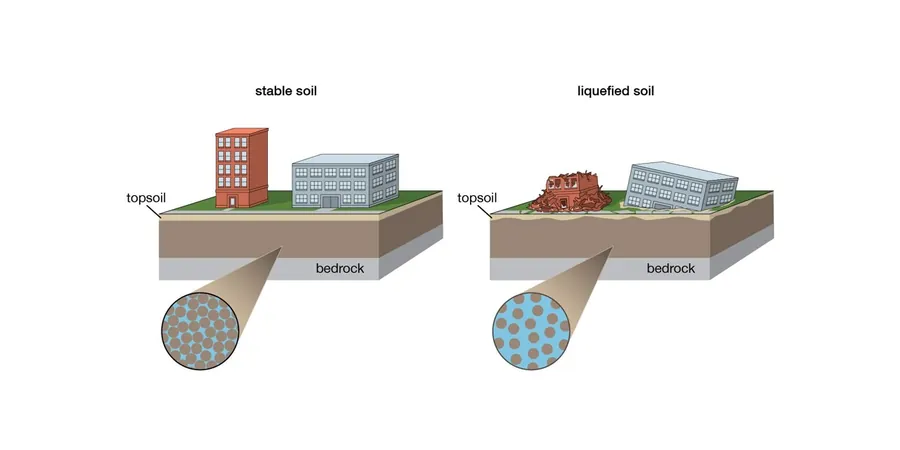
NBCC 2020 Clause 4.1.8.16 requires liquefaction assessment for Site Classes D and E when the seismic hazard exceeds 0.12g—a threshold that applies to much of Newmarket, particularly the lower-lying areas east of Yonge Street where silty sand fills and alluvial deposits predominate. The consequence of skipping this analysis is not just bearing capacity loss; it is the potential for lateral spreading toward buried infrastructure and foundation differential settlements exceeding 75 millimetres, which render a structure unserviceable even if it does not collapse. Post-liquefaction volumetric strain, estimated from SPT (N1)60cs values or CPT tip resistance normalized for overburden and fines, translates directly into repair costs that can triple the original structural budget. The engineering team must also consider that Newmarket’s moraine stratigraphy creates perched water tables that saturate otherwise competent-looking layers—a condition easily missed with conventional drilling alone. Our laboratory runs these calculations under ISO/IEC 17025-accredited protocols, ensuring the factor of safety against liquefaction is defensible to both the municipality and the structural engineer of record.
Applicable standards
NBCC 2020 Part 4 Seismic Hazard & Site Classification, ASTM D6066-11 Standard Practice for Determining Normalized Penetration Resistance of Sands, ASTM D5778-20 Standard Test Method for Electronic Friction Cone and Piezocone Penetration Testing, NCEER/NSF (Youd et al. 2001) Liquefaction Resistance of Soils: Summary Report, ISO/IEC 17025:2017 General requirements for laboratory competence
Associated technical services
CPT-Based Liquefaction Screening
Continuous seismic piezocone penetration testing with pore-pressure dissipation monitoring. We apply the Robertson (2009) soil behaviour type classification and calculate the cyclic resistance ratio (CRR) directly from normalized tip resistance (Qtn) and friction ratio (Fr). The method provides a near-continuous profile of factor of safety versus depth, ideal for identifying thin liquefiable seams that SPT sampling can miss. Includes Vs measurement via downhole geophone for site class determination.
SPT-Based Liquefaction Analysis with Laboratory Validation
Standard penetration testing with energy-calibrated automatic trip hammers (ER measured per ASTM D4633). We correct N-values for overburden, energy ratio, rod length, and fines content using laboratory grain-size and Atterberg test results from the same split-spoon sample. The Youd-Idriss simplified procedure yields the cyclic stress ratio (CSR) and factor of safety, plus post-liquefaction settlement estimates using Ishihara-Yoshimine volumetric strain charts.
Typical parameters
Frequently asked questions
Is all of Newmarket classified as high liquefaction risk under NBCC 2020?
No, but large portions of the town east of Yonge Street and along the Holland River corridor fall into Site Class D and E, where NBCC 2020 requires explicit liquefaction assessment if PGA exceeds 0.12g. The Oak Ridges Moraine highlands underlain by dense Newmarket Till generally classify as Site Class C and do not require liquefaction checks, though site-specific investigation is always prudent given the complex interlensing of glaciofluvial sands.