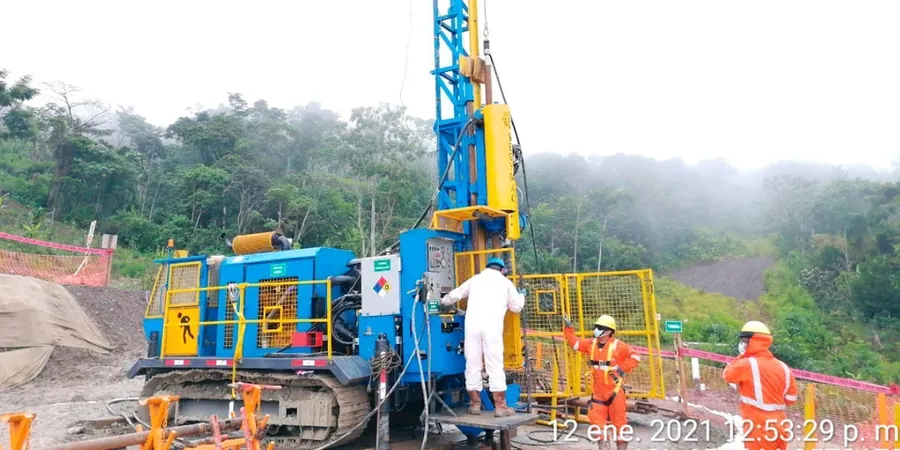
The Oak Ridges Moraine shapes everything we build on in Newmarket. This geological formation, with its mix of dense till, sand lenses, and occasional silt pockets, demands more than a quick look at the surface. A Standard Penetration Test directly measures how the soil resists a driven sampler, giving us the N-value that translates into bearing capacity and settlement estimates. We run SPT rigs across York Region, often hitting refusal on the Halton Till before reaching the 15-meter mark. For projects near the Holland River floodplain, where softer deposits can govern foundation design, pairing SPT data with a CPT profile clarifies the transition between loose and competent layers. The test itself follows ASTM D1586-18, providing a consistent benchmark that local geotechnical engineers rely on to meet National Building Code of Canada requirements for site classification.
N-value isn't just a number. In Newmarket's glacial deposits, it's the difference between a standard footing and a costly over-excavation.
Methodology and scope
Local considerations
A 6-storey residential building on Prospect Street ran into trouble when the initial design assumed a uniform till profile. Our SPT program in three boreholes discovered a 2-meter-thick pocket of soft clay at 7 meters, with N-values hovering around 3 blows. Without that data, the footings would have been under-designed for the differential settlement, potentially cracking the superstructure within the first few freeze-thaw cycles. The Newmarket area's variable stratigraphy, shaped by glacial Lake Algonquin's retreat, creates these hidden weak zones. We see the same risk in smaller projects: a medical office on Eagle Street where the SPT identified an old, undocumented fill area. The blow count dropped to zero for half a meter before hitting wood debris. The foundation was redesigned to bypass the fill entirely, avoiding a future that would have involved expensive underpinning and disruption to the clinic's operations.
Applicable standards
ASTM D1586-18: Standard Test Method for Standard Penetration Test (SPT) and Split-Barrel Sampling of Soils, NBCC 2020: National Building Code of Canada – Section 4.2, CSA A23.3-19: Design of Concrete Structures, ASTM D2488-17: Standard Practice for Description and Identification of Soils (Visual-Manual Procedure)
Associated technical services
Bearing Capacity Analysis for Footings
We correlate SPT N-values to allowable bearing pressure using established empirical methods, providing the parameters your structural engineer needs for isolated and strip footings on the Oak Ridges Moraine deposits.
Liquefaction Screening and Assessment
Using N1(60) values and the NCEER/Youd-Idriss procedure, we evaluate the liquefaction susceptibility of saturated sands beneath your site, a critical step for structures in Newmarket's lower-lying areas near the Holland River.
Stratigraphic Profiling and Logging
Every SPT spoon is opened, photographed, and logged by an experienced technician. We classify the material according to the Unified Soil Classification System, giving you a clean, defensible geotechnical cross-section.
Typical parameters
Frequently asked questions
How much does SPT testing cost in Newmarket?
SPT investigation costs in Newmarket typically range from CA$780 to CA$1,040 per borehole, depending on depth, access, and the number of tests required. This includes mobilization, drilling, sampling, logging, and a factual report with corrected N-values. A site with three boreholes to 10 meters might fall in the CA$2,500 to CA$3,200 range total.
How many SPT boreholes does my project need?
The number depends on the building footprint and the uniformity of the site. For a single-family home in Newmarket, we typically recommend at least two boreholes. A commercial building of 500 m2 or more often requires three to four boreholes to comply with NBCC 2020 requirements and to capture lateral variability in the Halton Till.
What depth do you typically drill in Newmarket?
We generally extend boreholes to at least 1.5 times the width of the foundation's influence zone. In Newmarket, that often means 8 to 12 meters for a standard building pad. If we encounter refusal on dense till earlier, the engineer may decide to terminate the borehole, provided the refusal N-value is properly documented.
Can you do SPT testing in winter conditions?
Yes, we operate year-round in Newmarket. Winter drilling requires heated equipment and careful management of drilling fluids to prevent freezing. Frozen ground at the surface is cased through quickly, and the SPT data below the frost line is unaffected. We have completed many January boreholes with no impact on sample quality or N-value reliability.