A few years back, during the expansion of a commercial plaza off Davis Drive, we saw a textbook case of why compaction matters in Newmarket. The native soil on site was a mix of silty sand and clay till—typical for the Oak Ridges Moraine deposits scattered across this part of Ontario. The structural engineer had specified 98% Standard Proctor density under the footings, but the first lift of imported granular fill came in at barely 91%. The contractor was frustrated, thinking the lab numbers were off. What the sand cone test revealed, however, was uneven moisture conditioning and insufficient pass counts on that northwest corner where the grade dipped toward a drainage swale. When you’re dealing with the freeze-thaw cycles we get here—Newmarket averages around 220 centimetres of snow a year and plenty of spring melt—poorly compacted fill turns into a liability faster than people realize. That’s where a properly executed field density test with the sand cone method becomes indispensable: it gives you a direct, physical measurement of in-place density, not an indirect reading from a nuclear gauge that can drift with moisture and soil chemistry. For projects that need defensible QA/QC records, especially public-sector work in York Region, we often pair this with a Proctor curve from our lab to establish the reference maximum dry density before heading to the field.
A sand cone test gives you the density that actually exists in the ground—not a modelled density, not a correlated density, but a direct physical measurement anyone can verify.
Methodology and scope
Local considerations
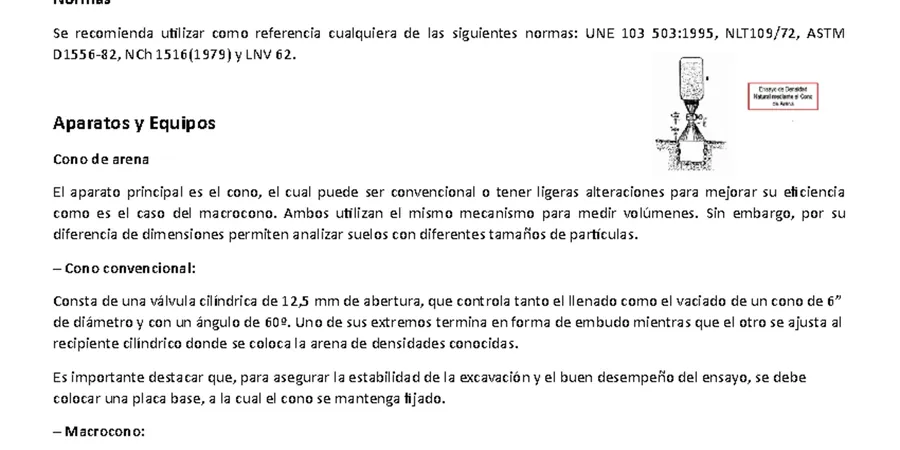
The field kit is deceptively simple: a sand cone apparatus with a one-gallon jar, a metal base plate with a flanged hole, a digging chisel, and a container of calibrated sand. The technician sets the plate on the prepared surface, excavates a circular hole through the plate opening—typically 100 to 150 millimetres in diameter—and carefully collects every gram of soil removed. The hole is then backfilled with the calibrated sand from the jar, and the mass of sand required to fill the void directly gives the volume of the test hole. When the local fill contains cobbles or chunks of weathered shale from the Queenston Formation (visible in some deeper excavations near the Holland River corridor), the technician must exercise real judgment about how to handle oversized particles. The ASTM D1556 procedure has a correction method for particles retained on the 19-millimetre sieve, but applying it correctly in a Newmarket winter trench with frozen crust on the surface takes experience. The biggest risk we see is not the test itself but the sampling interval: a contractor compacts a 300-millimetre lift, but the sand cone only samples the upper half of that lift. If the bottom of the lift is less compacted—which happens when roller passes are too few or the lift is too thick—the test can give a misleadingly optimistic result. For that reason, on critical fills like those under shallow footings, we recommend density tests at multiple depths within the same lift, or pairing the sand cone with a dynamic cone penetrometer for a continuous profile.
Applicable standards
ASTM D1556: Standard Test Method for Density of Soil in Place by the Sand-Cone Method, AASHTO T-191: Density of Soil In-Place by the Sand-Cone Method, ASTM D698: Standard Proctor (reference maximum dry density), ASTM D1557: Modified Proctor (when specified for higher compaction energy), Ontario Building Code (OBC) reference to CSA A23.3 for structural fill verification
Associated technical services
Compaction Verification for Engineered Fill
In-place density testing using the sand cone method on structural fill, backfill behind retaining walls, trench reinstatements, and subgrade preparation. Each test point is documented with GPS coordinates, lift thickness, material type, and percent compaction relative to the laboratory Proctor standard.
QA/QC Density Monitoring Programs
Long-term compaction monitoring for subdivision development, commercial pad construction, and municipal infrastructure in Newmarket and the broader York Region. We establish testing frequencies aligned with the project’s geotechnical specifications and provide daily or weekly summary reports with statistical trending.
Typical parameters
Frequently asked questions
How much does a sand cone density test cost in Newmarket?
For a single test point with a laboratory Proctor reference, budget between CA$140 and CA$190 in the Newmarket area. The final cost depends on how many points you need in a day, travel distance, and whether a Proctor curve already exists for your fill material. A full-day program with multiple test locations typically has a lower per-point rate.
Why choose the sand cone method over a nuclear density gauge?
The sand cone method is a direct volumetric measurement, so it is not affected by soil chemistry, iron content, or moisture fluctuations the way a nuclear gauge can be. In the silty tills and mixed fills common around Newmarket, this direct approach often avoids disputes over gauge calibration. It also requires no radiation licensing or safety barriers, which simplifies work on occupied sites.
How long does a field density test take on site?
A single sand cone test takes about 20 to 35 minutes from setup to clean-up, including excavation, sand pouring, and collection of the soil sample for moisture determination. If multiple tests are required across a larger site, we can typically complete four to six points in a half-day, depending on access and the number of lifts being tested.
What compaction percentage is required for structural fill in Newmarket?
Most geotechnical specifications in Newmarket call for 95 to 98 percent of Standard Proctor maximum dry density for fill beneath footings, slabs-on-grade, and pavement subgrades. The exact number depends on the structure type and soil conditions, but 98 percent is the common benchmark for heavily loaded footings and critical infrastructure in York Region.