Newmarket sits on a complex glacial stratigraphy that shifts from dense Halton Till to loose sand channels within a few meters. At roughly 240 m above sea level, the water table in the Holland River lowlands complicates every excavation deeper than 4.5 m. The 2020 NBCC requires site-specific design when adjacent structures fall within the zone of influence, and that rule alone triggers a geotechnical design of deep excavations on most downtown infill lots. Our team models staged cuts, tieback preload, and basal heave before a single bucket hits the ground. For sites where the shoring must hold back saturated sand lenses, we integrate in-situ permeability data directly into the seepage model to size the dewatering system correctly.
In Newmarket glacial sequences, a shoring design that works for 5 m of till can fail at 6 m when it hits the sand unit beneath.
Methodology and scope
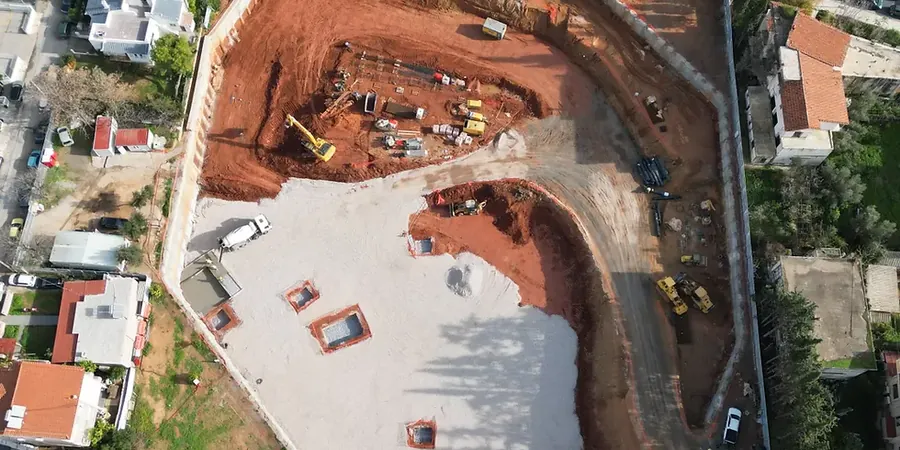
Local considerations
The freeze-thaw cycle in Southern Ontario is relentless on exposed excavation faces. A cut that looks stable in October can spall and lose 150 mm of face material by February. Deep excavation design in Newmarket has to account for that seasonal degradation because it changes the arching action between soldier piles. Spring melt drives the water table up fast, and sump pumps that were adequate in summer suddenly cannot keep the base dry. The biggest financial risk for a contractor is basal heave in the lower sand unit: once the floor starts to rise, re-stabilizing the cut costs more than the original shoring. Our design reports quantify that heave factor of safety and specify the required embedment depth to keep it above 1.5 under the highest anticipated groundwater level.
Applicable standards
NBCC 2020 Part 4 – Structural Design, CSA A23.3-19 – Design of Concrete Structures, FHWA GEC No. 2 – Earth Retaining Structures, FHWA GEC No. 4 – Ground Anchors and Anchored Systems, OPSS.MUNI 206 – Excavation and Backfill (Ontario)
Associated technical services
Shoring Design & Analysis
Full staged-excavation models with tieback or internal bracing. We size soldier piles, walers, and concrete facing using CSA A23.3 load combinations and provide the lateral deflection envelope required by the Town's building department.
Dewatering & Base Stability Review
Seepage analysis paired with heave checks for cuts that penetrate the till-sand contact. We specify well spacing, screen depth, and standby pump capacity so the excavation stays dry during spring groundwater peaks.
Typical parameters
Frequently asked questions
What does a deep excavation design package cost for a Newmarket project?
For most commercial and mixed-use excavations in Newmarket, the geotechnical design of deep excavations runs between CA$2,850 and CA$12,320 depending on cut depth, number of shoring stages, and whether tiebacks or internal bracing is required. A simple single-stage soldier pile design under 6 m sits at the lower end; a multi-level anchored wall with 3D corner analysis and seepage modeling approaches the upper range.
How long does the design and approval process take?
We typically deliver a preliminary shoring concept within 8–10 business days after receiving the geotechnical baseline report and survey. The final stamped package, including construction-stage sequencing and monitoring thresholds, adds another two weeks. Town of Newmarket site plan review timelines vary, but we submit directly to the plans examiner and address comments within 48 hours.
Do you design both temporary and permanent shoring walls?
Yes. Temporary walls are optimized for construction loads and a 12–24 month service life. Permanent walls—common for underground parking in Newmarket—include durability requirements from CSA A23.3, waterproofing interface details, and long-term earth pressure coefficients that account for soil creep in the Halton Till.
What soil information do you need before starting the design?
At minimum, we need borehole logs with SPT N-values to refusal depth, laboratory shear strength from triaxial or direct shear tests, and standpipe piezometer readings taken during a wet season. If the excavation extends below the water table, a pumping test or in-situ permeability measurement is essential for the dewatering model.