Newmarket sits on a complex glacial stratigraphy: dense Halton Till overlying stratified sand and silt lenses at depths between 6 and 12 metres. Groundwater perched within those sand seams creates lateral pressure spikes that standard wall sections cannot handle without proper drainage design. For any retaining wall higher than 1.2 metres — or any wall supporting a driveway or structure — Ontario Building Code triggers mandatory geotechnical input. The town’s frost penetration depth reaches 1.5 metres, which means footing depth and backfill material selection must account for freeze-thaw cycles that degrade poorly graded fills within two seasons. A slope stability analysis becomes critical when walls are stepped along the rolling topography east of Yonge Street, where natural grades exceed 15 percent and surcharge loads from adjacent properties shift the failure plane.
A retaining wall is a drainage structure first, a structural element second — in Newmarket’s glacial soils, water management dictates service life.
Methodology and scope
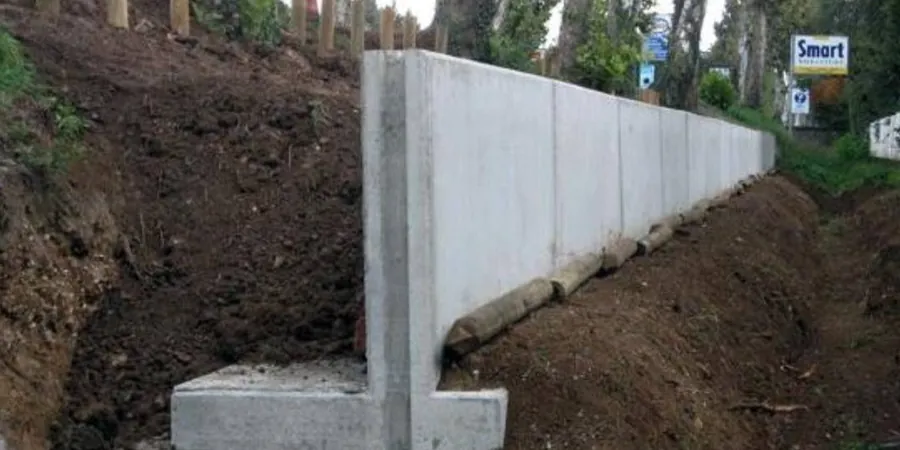
Local considerations
A track excavator arrives on site and the operator begins cutting the wall bench into the slope face. Without a geotechnical inspection, the crew cannot distinguish weathered till from intact till — the oxidized brown crust looks competent but crumbles under footing load. In Newmarket’s spring thaw conditions, a saturated silt lens exposed at the bench toe can liquefy under vibratory compaction of the base gravel, triggering a shallow rotational slide that takes out the excavation support. The design must specify a minimum stand-up time for open cuts, a bench drainage protocol, and a hold point for subgrade inspection before reinforcement placement. Walls constructed without these controls near the Holland River floodplain have failed during single-event rainstorms exceeding 50 mm in 24 hours, a recurrence threshold well documented in TRCA flood records.
Applicable standards
NBCC 2020 Division B Part 4 (Structural Design), CSA A23.3:19 (Design of Concrete Structures — Annex D), OPSS 1010 (Granular Backfill and Filter Material), CSA S6:19 Canadian Highway Bridge Design Code (where applicable), ASTM D2488 (Soil Description — Visual-Manual for field logging)
Associated technical services
Geotechnical Investigation for Walls
Borehole drilling and test pitting to define till stratigraphy, perched water levels, and shear strength parameters for active/passive earth pressure calculations.
Structural Retaining Wall Engineering
Design of gravity walls, cantilever reinforced concrete walls, and segmental block walls with geogrid reinforcement, including overturning, sliding, bearing, and internal stability checks.
Drainage and Waterproofing Specification
Design of chimney drains, perforated collector pipes, filter fabric selection, and surface swales to intercept runoff before it saturates the retained soil mass.
Construction Review and Subgrade Inspection
Site visits at key hold points: bench excavation approval, reinforcement placement verification, backfill compaction testing using nuclear density gauge per ASTM D6938.
Typical parameters
Frequently asked questions
What retaining wall designs are suitable for Newmarket’s clay till soils?
Cantilever reinforced concrete walls and segmental block walls with geogrid reinforcement both perform well in Halton Till, provided the base is embedded below frost depth and a positive drainage system is installed. Gravity walls taller than 1.5 metres become uneconomical in till because the required mass to resist sliding grows rapidly. The key parameter is the drained friction angle of the foundation till: we test this using direct shear or triaxial methods and use it to size the base width for a sliding factor of safety of 1.5 or higher.
How much does a retaining wall design cost in Newmarket?
Design fees for a retaining wall in Newmarket typically range from CA$1,220 to CA$5,960 depending on wall height, complexity, and whether new borehole investigation is required. A simple gravity wall under 1.2 metres with existing soil data falls at the lower end; a reinforced cantilever wall over 2.5 metres requiring slope stability analysis and shoring design falls at the upper end.
Do I need a building permit for a retaining wall in Newmarket?
Yes. The Town of Newmarket requires a building permit for any retaining wall exceeding 1.0 metre in height, or any wall supporting a surcharge such as a driveway or building. The permit application must include stamped engineering drawings, a geotechnical report, and a site plan showing setbacks from property lines. Walls under 1.0 metre that do not support a surcharge are generally exempt but must still comply with the Ontario Building Code’s lateral support provisions.