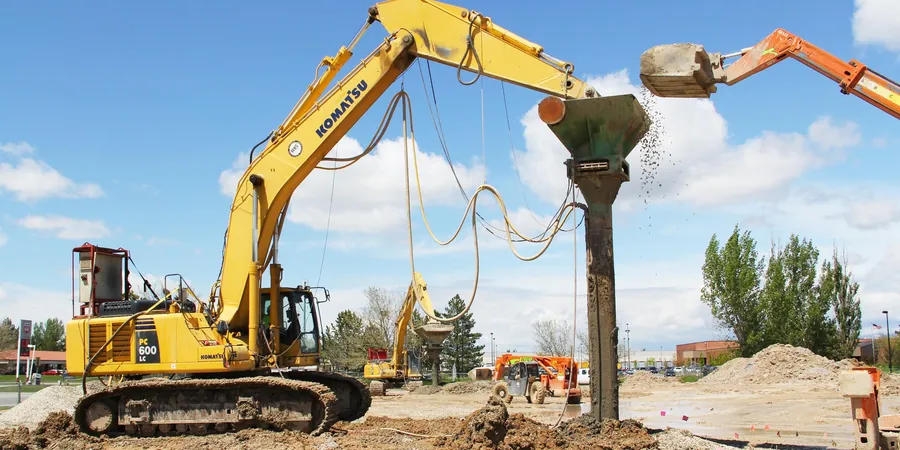
The Oak Ridges Moraine defines Newmarket’s subsurface: alternating layers of loose sand, silt, and hard till deposited by glacial retreat. Borehole data across the town show SPT N-values below 10 in the upper 4 to 6 metres along the Holland River corridor. When a four-storey mixed-use project on Davis Drive encountered differential settlement in 2022, the geotechnical review pointed directly to untreated loose granular lenses. A properly engineered vibrocompaction design eliminates these pockets before footings are poured, using depth-specific vibration to rearrange grains into a denser fabric. For sites where CPT tip resistance drops under 5 MPa, this technique delivers measurable improvement without excavation, and the design sequence integrates directly with in-situ permeability testing when groundwater flow must be preserved beneath compacted zones.
A well-calibrated vibrocompaction grid can raise relative density from 40 to 75 percent in two passes when sand fines stay below 12 percent.
Methodology and scope
Local considerations
Newmarket’s expansion through the 1990s pushed residential subdivisions onto former agricultural land underlain by loose deltaic sands deposited by ancestral Lake Algonquin. Early builders sometimes skipped deep compaction, relying on shallow spread footings that later experienced total settlements of 40 to 70 millimetres within five years. The risk repeats today wherever infill lots sit on uncompacted sand lenses: differential movement cracks partition walls, binds windows, and strains buried utility connections. A site-specific vibrocompaction design breaks that chain by targeting the loose horizon before structural loads are applied, reducing post-construction settlement to less than 15 millimetres when verified by CPT. In seismic terms, densification also pushes the cyclic resistance ratio above the NBCC threshold for magnitude 6.0 events, cutting liquefaction susceptibility in the upper 10 metres.
Applicable standards
NBCC 2020 Division B, Part 4 – Geotechnical design requirements, CSA A23.3:2019 – Concrete structures (foundation interaction), ASTM D5778-20 – CPT standard for verification testing, ASTM D4253/D4254 – Maximum and minimum index density of soils
Associated technical services
Pre-treatment CPT investigation
Cone penetration testing on a 15-metre grid to map loose lens thickness, tip resistance, and friction ratio before designing the vibration grid.
Vibrocompaction grid design
Selection of probe spacing, energy input, and lift sequence based on grain-size curves and target relative density per NBCC.
Post-treatment QC and reporting
Post-compaction CPT soundings at grid centres and midpoints, with summary report confirming density improvement and settlement reduction.
Typical parameters
Frequently asked questions
What soil conditions in Newmarket make vibrocompaction suitable?
The technique works best in clean to slightly silty sands with fines content below 15 percent. Much of Newmarket south of Green Lane sits on loose glacial outwash that matches this profile. When silt or clay layers exceed 0.3 metres in thickness, the design evaluation includes alternative methods like stone columns because vibration energy attenuates across cohesive seams.
How much does a vibrocompaction design package cost for a typical Newmarket lot?
Design fees for a single-lot residential or small commercial site in Newmarket generally range from CA$2,150 to CA$6,190, depending on the number of CPT soundings required and the complexity of the treatment grid. Larger multi-building projects are quoted after reviewing the geotechnical baseline report.
How is compaction performance verified after treatment?
The standard approach uses pre- and post-treatment CPT soundings at the same locations. Acceptance is based on achieving a minimum relative density of 70 percent or a target tip resistance specified in the design. Additional checks with dynamic cone penetration may supplement the CPT data on smaller sites.