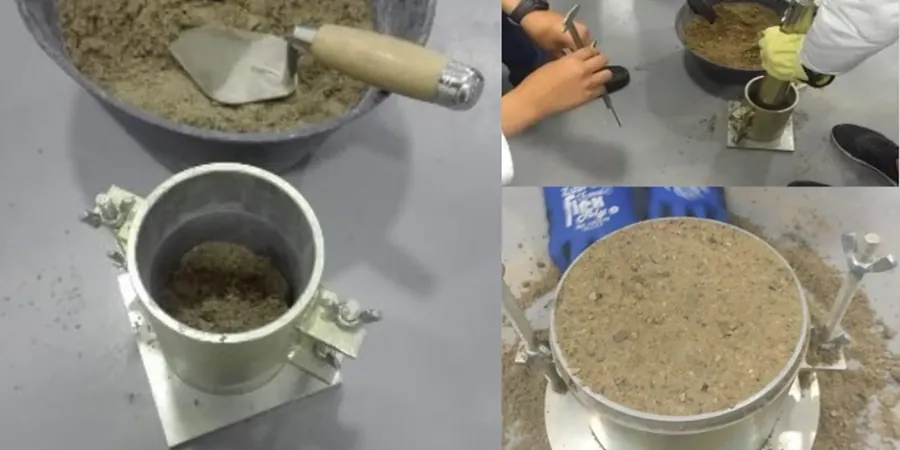
On a recent morning out toward the Holland River flats, a crew stopped mid-lift because the fill just wasn't packing right. Newmarket's glacial till, a mix of silty sand and clay laid down by Lake Algonquin, can shift its moisture behavior from one truckload to the next. That's exactly when a sand cone density test paired with a Proctor curve stops being paperwork and starts being profit protection. We run both the Standard Proctor (ASTM D698) and the Modified (ASTM D1557) right here, matching the compactive effort to what your spec actually demands. No generic curves pulled from a database. Every maximum dry density and optimum moisture content we report comes from material scooped off your site, because Newmarket's subgrade does not read the textbook.
A Proctor number only matters if it represents the exact fill entering your lift, not a regional average.
Methodology and scope
Local considerations
Ontario Building Code references ASTM D698 and D1557 as the basis for engineered fill acceptance, and most Newmarket project specs tie compaction directly to 95% or 98% of the laboratory maximum. A curve built on the wrong compactive effort or a poorly representative sample triggers a chain reaction: failing nuclear gauge readings, field disputes, and truckloads of rejected material sitting idle. In the silty tills common around Bathurst and Davis Drive, moisture is the trap. A half-percent deviation from optimum can drop density below spec fast. We flag that early, running the full five-point curve with precise moisture control so the field crew has a target they can actually hit with a sheepsfoot roller.
Applicable standards
ASTM D698-12e2, ASTM D1557-12e1, Ontario Building Code – Part 4
Associated technical services
Standard Proctor (ASTM D698)
The 12,400 ft-lbf/ft³ effort for typical building pads, utility trench backfill, and landscape subgrade. We deliver the curve and the plotted data within 48 hours.
Modified Proctor (ASTM D1557)
The 56,000 ft-lbf/ft³ effort required for heavy highway base, airport pavement, and industrial slabs. Same-day sampling, rapid turnaround.
Typical parameters
Frequently asked questions
What does a Proctor compaction test cost in Newmarket?
For projects in the Newmarket area, a single-point or full-curve Proctor test generally falls in a budget range of CA$150 to CA$330, depending on whether it is Standard or Modified and how many molds are required. We provide a firm quote after confirming your material type and specification.
Which test do I need for a residential foundation in Newmarket, Standard or Modified?
Most residential foundation backfill in Newmarket is specified at Standard Proctor effort (ASTM D698) with 95% or 98% relative compaction. The Modified Proctor is typically reserved for engineered structural fill under slabs or heavy driveways. We always cross-check your geotechnical report to confirm.
How long does it take to get results?
We typically report maximum dry density and optimum moisture content within 48 hours of receiving the sample. For earthworks crews operating on tight timelines near Green Lane or Yonge Street, we can arrange same-day testing with advance notice.
Can you test material with gravel larger than 3/4 inch?
Yes. When the sample contains significant plus-¾-inch material, we apply ASTM D4718 correction or switch to Method C using the 6-inch mold. The key is capturing a representative sample, not just the fines, so your field density tests correlate properly.