The complex glacial stratigraphy beneath Newmarket’s expanding subdivisions—where stiff Halton Till overlies softer glaciolacustrine silts and clays from ancestral Lake Algonquin—demands more than just index properties for critical foundation design. When a seven-storey mixed-use project on Davis Drive encountered groundwater seepage at just 3.2 meters within a dense silt unit, the structural engineer required effective stress parameters to finalize the footing dimensions. That’s where a consolidated-undrained triaxial test with pore pressure measurement becomes essential. Our testing program in Newmarket routinely isolates undisturbed Shelby tube samples from depths of 5 to 18 meters, subjecting them to multi-stage loading to define the Mohr-Coulomb failure envelope that governs bearing capacity calculations under the Ontario Building Code. Because the town sits along the northern flank of the Oak Ridges Moraine, lateral variability in soil fabric—from laminated clays near Fairy Lake to stony matrix tills east of Highway 404—means each borehole tells a different story, and shear strength parameters must be validated site by site.
A single CU triaxial test on an undisturbed Newmarket clay sample can reveal strain-softening behavior that reduces the design shear strength by 30%, a detail no SPT correlation can capture.
Methodology and scope
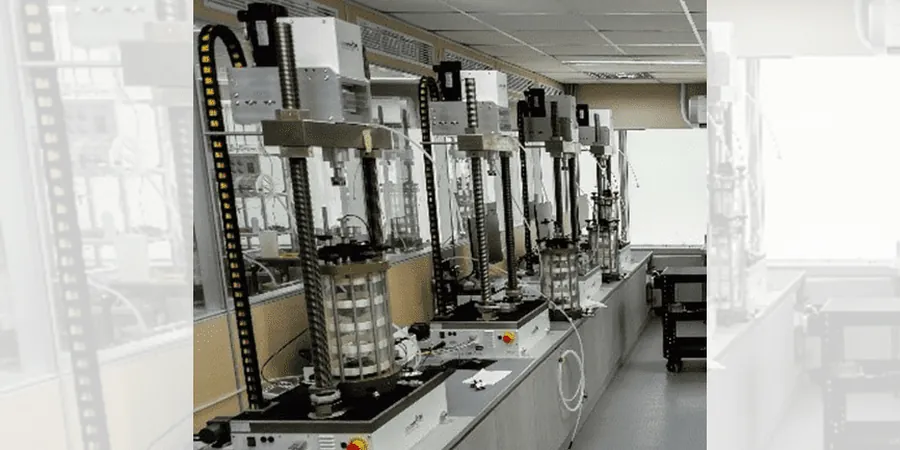
Local considerations
The risk profile for a triaxial testing program in Newmarket changes dramatically depending on whether you are drilling on the flat-lying organics of the Holland Marsh—where peat layers can exceed 4 meters in thickness and produce virtually zero effective cohesion—or on the compact till uplands near the Newmarket Community Centre, where overconsolidation ratios often surpass 8 and yield friction angles above 34 degrees. We have seen projects where a single triaxial test on a high-quality sample from the marsh area revised the bearing capacity downward by 40% compared to the initial SPT-based estimate, forcing a switch from spread footings to driven piles. Another scenario that repeats itself in the Yonge Street corridor involves interbedded sand and clay lenses; if the triaxial specimen is inadvertently trimmed from a clay seam while the sand layer governs drainage, the undrained strength could be overestimated by a factor of 1.5 or more. Sample disturbance is the silent variable that can render a triaxial dataset useless—Newmarket’s sensitive laminated clays are particularly prone to swelling and microfracturing during extrusion, which is why we use a field extrusion system with internal cutting shoes and transport the tubes horizontally to minimize fabric damage before trimming in a humid room.
Applicable standards
ASTM D4767-11: Standard Test Method for Consolidated Undrained Triaxial Compression Test for Cohesive Soils, ASTM D7181-20: Standard Test Method for Consolidated Drained Triaxial Compression Test for Soils, Ontario Building Code 2012 (O. Reg. 332/12), Division B, Part 4, Section 4.2 (Foundation Design), Canadian Foundation Engineering Manual (CFEM) 4th Edition, Chapter 3 (Shear Strength)
Associated technical services
Consolidated Undrained (CU) Triaxial with Pore Pressure Measurement
The core test for Newmarket's cohesive soils, providing undrained shear strength (su) and effective stress parameters (c', φ') from a single multi-stage loading sequence. We saturate specimens to a minimum Skempton B-value of 0.95 and shear at rates derived from consolidation data to ensure uniform pore pressure distribution throughout the sample.
Consolidated Drained (CD) Triaxial for Granular and Stiff Overconsolidated Soils
Applied to the dense till and outwash sand layers that characterize the deeper Oak Ridges Moraine deposits in Newmarket. Drained shearing at rates slow enough to dissipate excess pore pressure yields the critical state friction angle (φ'cs) used in long-term slope stability and retaining wall design.
Unconsolidated Undrained (UU) Triaxial for Preliminary Site Assessment
A rapid screening test for comparing the undrained shear strength of clay samples across different boreholes and depths. Although UU tests do not provide effective stress parameters, they are useful for identifying weak zones in the Holland Marsh organic silts where more comprehensive CU testing should be focused.
Typical parameters
Frequently asked questions
How much does a consolidated undrained triaxial test cost for a Newmarket project?
A standard CU triaxial test with pore pressure measurement on a single specimen typically ranges from CA$2.800 to CA$3.560, depending on the number of confining stages and whether the sample requires special handling due to sensitivity. A full testing program for a mid-rise building in Newmarket, including three CU tests at different depths plus one CD test on the till layer, generally falls within the upper end of that per-specimen range when you account for sample preparation, back-pressure saturation, and the engineering report with Mohr-Coulomb parameter derivation.
What is the difference between UU, CU, and CD triaxial tests, and which one does my Newmarket site need?
In Newmarket's glacial soils, the choice depends on the drainage conditions during construction and the design timeline. An unconsolidated undrained (UU) test gives a quick undrained strength for short-term stability—useful for checking trench safety in clay. A consolidated undrained (CU) test with pore pressure measurement provides both undrained strength and effective stress parameters (c', φ'), which is what you need for bearing capacity and slope stability during and immediately after construction. A consolidated drained (CD) test allows full pore pressure dissipation and yields the critical state friction angle for long-term conditions, essential for permanent retaining walls in the Oak Ridges Moraine till. Most Newmarket projects require at least CU testing; sites with thick sand layers or sensitive clays benefit from a combination of CU and CD protocols.
How do you prevent sample disturbance in Newmarket's sensitive laminated clays during triaxial testing?
Sample disturbance is the most critical quality factor in our Newmarket triaxial program, especially for the laminated glaciolacustrine clays that lose strength irreversibly when fractured. We use a field extrusion system that pushes the sample out of the Shelby tube directly into a split mold with an internal cutting shoe, minimizing exposure to air and mechanical deformation. The tubes are transported horizontally in insulated boxes and stored in a humid room at 20°C within 24 hours of extraction. Before trimming, we let the sample equilibrate to room temperature and inspect it under a bright light for fissures or swelling; any specimen with visible disturbance is rejected. During the saturation phase, we ramp back-pressure slowly—typically 50 kPa per hour—to dissolve air without collapsing the soil fabric. These steps consistently achieve B-values above 0.95, which is the threshold for reliable effective stress measurement. More info.